



How to Choose Non Toxic Blackout Shades for a Healthier Home
Choose non toxic blackout shades by checking the complete fabric construction and current third-party testing. The face fabric, blackout backing, and added treatments should all be included in that review. Material names alone provide limited evidence. Certification scope and complete material disclosure are more useful than broad natural or eco-friendly claims.
How Can You Tell If Blackout Shade Fabric Is Non Toxic?
Check the full material composition and identify what each certification covers. The decorative surface may use a different material from the layer responsible for blocking light.
Read the Complete Fabric Composition
Start with the percentage of each fiber. A shade described as linen may use a linen texture instead of natural linen fiber. It may also combine a natural surface with a synthetic backing. Ask the seller to identify both sides of the material.
When comparing blackout roller shades, check whether the specification lists the face fabric and blackout layer separately. A complete description should identify any coating that creates the opaque surface.
Check the Blackout Backing
The backing is often more important than the visible surface when evaluating non toxic blackout shades. It creates opacity and may contain different polymers or adhesives.
PVC-free can be a useful requirement for buyers who want to avoid vinyl backing. Ask what material replaces the PVC because the claim does not explain whether the alternative uses acrylic or another coating.
A multilayer woven construction may achieve opacity by combining dense layers. Coated fabrics form a continuous barrier on the rear surface. Either construction can work when the manufacturer provides relevant testing for the finished material.
Use Certifications for the Right Purpose
No single certification answers every material question. Match the standard to the substance or emission concern you want it to address.
|
Certification |
What it evaluates |
What you should verify |
|
OEKO-TEX STANDARD 100 |
Harmful substances in textile components |
The chosen fabric and backing appear within the scope |
|
GREENGUARD Gold |
Chemical emissions released into indoor air |
The product appears in the UL certification database |
|
GOTS |
Organic fibers and textile processing |
Certification covers the finished textile |
|
RoHS |
Restricted substances in electronic equipment |
Compliance applies to the motor and electrical parts |
Verify the Certificate Number and Scope
Ask for the complete certification name and certificate number. The document should identify the manufacturer and covered product group. Enter an OEKO-TEX number in the official Label Check. A valid result should match the fabric or finished product offered by the seller.
Search GREENGUARD claims in the UL database. Confirm whether the listing covers the full shade, the fabric collection, or only one component.
A certification logo without a number provides little verification. Request the supporting document before ordering a custom product with limited return options.
Order the Exact Fabric Sample
Place the sample near the planned window for several days. A strong odor may help you reject an unsuitable fabric. A weak odor cannot establish that chemical emissions are low because some VOCs have little noticeable smell.
Hold the sample against direct daylight and check for a general glow or small bright points. Use this test only to judge opacity. Material safety still depends on composition and suitable testing.
Gently flex the sample and inspect the rear surface. Avoid materials that crack or shed particles during light handling.
Ask About Added Treatments
Ask whether the fabric includes added stain resistance or antimicrobial treatment. These features may introduce chemicals that are unrelated to light blocking.
Request more detail when a shade is described as flame resistant. The performance may come from the fiber construction or from a finish applied after the fabric was made.
The same material review applies to motorized shades. Motorization changes the operating system, while the fabric still requires its own composition and certification records.
Broad terms such as healthy fabric and sustainable material provide little evidence by themselves. A useful answer should identify the relevant treatment and the test used to support the claim.

Which Materials Work Best for Non Toxic Blackout Shades?
The material should provide opacity without relying on undisclosed coatings. Tested polyester is often the most practical option for full blackout, while natural fibers may require an additional lining.
Certified Polyester Can Provide Reliable Blackout
Polyester is widely used in blackout roller shades because it holds a stable shape and supports opaque construction. Its synthetic origin does not reveal whether the fabric has low emissions or contains a particular finish. Look for testing that covers the exact polyester fabric and backing.
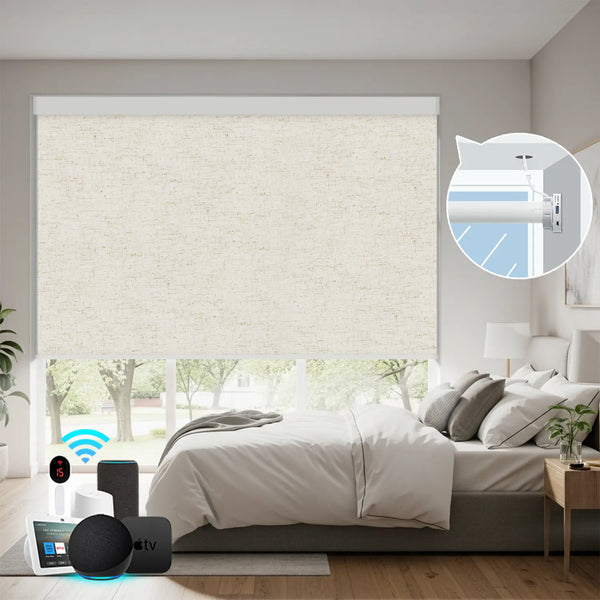
The Bringnox Motorized Roller Shades 100% Blackout Linen uses an opaque linen textured fabric with a multilayer backing. This construction blocks light through the panel while providing nighttime privacy. It has UL and RoHS credentials and describes the material as non toxic.
Its cordless motor operates below 45 dB. A full charge is rated for about 650 cycles or four to six months of typical operation, reducing how often the shade needs to be handled or charged.

Natural Face Fabrics Need a Suitable Lining
Cotton and linen provide a natural surface, though a single layer often allows visible light through. Dense fabric or an additional liner is usually required for stronger darkness.
Check the liner separately. An organic cotton face does not provide information about a polyester or acrylic layer attached behind it.
GOTS certification can support claims about organic fiber and textile processing. Confirm that certification continues through the finished textile instead of covering only the original fiber.
Compare Coatings as Separate Materials
PVC forms a durable opaque surface and can resist moisture. Buyers who want PVC-free blackout shades should look for a disclosed acrylic backing or woven multilayer alternative.
Acrylic coatings can provide good opacity with a softer surface. The presence of acrylic still needs to be disclosed because a natural-looking face fabric may hide the coating.
The Bringnox Hardwired Motorized Roller Shades 100% Blackout Linen lists OEKO-TEX and UL certified fabrics with a light-blocking rear coating. The opaque construction addresses panel leakage while the cordless motor removes an exposed operating loop.
What Should You Check Before Ordering Non Toxic Blackout Shades?
Compare chemical evidence and functional performance before placing a custom order. A tested material still needs the correct opacity and dimensions to work as a blackout shade.
|
Buying question |
Stronger evidence |
Warning sign |
|
What is the complete composition |
Face fabric and backing are identified |
Only the visible fabric is listed |
|
Which certification applies |
A current number matches the product |
A logo appears without supporting details |
|
How is blackout measured |
The fabric is opaque with zero openness |
Room darkening is presented as full blackout |
|
Can you order a sample |
The exact fabric and backing are supplied |
The sample uses another construction |
|
How is the shade operated |
The control is cordless or inaccessible |
A long operating loop remains exposed |
Confirm Zero Openness and Finished Fit
True blackout roller shades should use fabric with zero openness. But the openness only describes the panel. An inside-mounted roller shade may still leave narrow gaps because the fabric needs clearance to move.
Check whether the ordered width refers to the complete shade or the fabric panel. An outside mount with sufficient overlap can reduce edge light when the window recess cannot support side channels.
Review the Product Documents Together
Compare the material specification with the certificate. The fabric name and product range should match across both documents.
Check the return policy after approving the sample. Custom shades may have limited return options once the selected fabric has entered production.
Keep copies of the product page and certification record. They provide a reference if the delivered material differs from the sample or written specification.
FAQs
Are recycled blackout fabrics automatically safer?
No. Recycled content identifies the source of the fiber. The finished fabric still needs testing for relevant substances and chemical emissions.
Can airing out a shade remove every VOC?
No. Ventilation may reduce some initial emissions and odors. It cannot verify that every chemical has disappeared.
Are dark blackout fabrics more toxic?
No. Color alone does not determine toxicity. Check the dye process and certification for the exact color selected.
Can non toxic blackout shades develop mold?
Yes. Moisture can remain between a closed shade and wet glass. Control condensation and let the material dry fully.
Should blackout fabric touch the window glass?
Usually no. Follow the manufacturer’s clearance requirements. Repeated contact with condensation may damage the backing or keep it damp.
Conclusion
Choose non toxic blackout roller shades by verifying the whole fabric construction. Check the face material and blackout backing, then match each certification to the concern it actually evaluates.
Order the exact sample before buying. After verifying the material, confirm zero openness and sufficient window coverage so the shade provides the expected darkness.