



How Do Zebra Shades Work? The Exact Mechanism Explained
Zebra shades use one continuous striped fabric to create two layers in front of a window. Turning the roller shifts those layers past each other, causing their sheer and solid bands to align, overlap, or separate. This movement changes the amount of light and visibility through the shade. Keep the roller turning, and the same mechanism raises or lowers the entire window covering.
What Are Zebra Shades?
Also known as layered shades or banded shades, zebra shades combine the rolling action of a roller shade with the adjustable light control of a layered fabric. Their distinctive stripes are functional rather than purely decorative.
Across the fabric, open mesh sections alternate with denser solid sections. The front and rear layers carry matching patterns, so their bands can occupy different positions as the fabric moves. When both sheer sections meet, they create a filtered opening. Shift one layer slightly, and a solid band begins to cover that opening.
The Main Parts of a Zebra Shade
Several compact components work together inside the shade. Hardware shape varies by manufacturer, but these functions remain broadly consistent across most zebra-shade designs.
|
Part |
Function |
|
Roller tube |
Moves and collects the striped fabric |
|
Continuous fabric |
Creates the front and rear layers |
|
Sheer bands |
Admit filtered light and preserve some visibility |
|
Solid bands |
Cover the sheer openings for stronger privacy |
|
Bottom rail |
Redirects the fabric and maintains tension |
|
Headrail or cassette |
Supports and protects the upper assembly |
|
Control system |
Supplies the force that turns the roller |
How Do Zebra Shades Work?
The zebra shade mechanism performs two jobs with one roller: it changes the relationship between the stripes, and it controls how much of the window is covered.
A Continuous Fabric Path Produces Two Layers
Most zebra blinds are made from a single length of striped fabric that extends from the upper mechanism, travels down the front of the window, curves around the bottom rail, and returns toward the headrail. That return path is what creates the second layer.
Because both visible layers belong to the same fabric system, movement at the roller changes their position relative to one another. The layers remain close together, but they do not need to move in perfect unison.
The Roller Tube Creates Relative Movement
Hidden inside the headrail or cassette, the roller tube is the main moving component. As it turns, it draws in fabric from one part of the continuous path. That action pulls the material around the bottom rail and shifts the front stripe pattern against the rear pattern.
Nothing about the fabric’s transparency actually changes. The roller simply places different bands in front of each other.
The Bottom Rail Guides the Fabric
At the lower edge, the fabric must reverse direction without folding or losing alignment. The bottom rail provides the controlled path needed for that turn. Its weight also helps tension the fabric. With balanced tension, both layers hang flatter and track more predictably.
If the headrail is installed out of level, however, the material may drift toward one side. Wrinkles, rubbing, or stripes that no longer meet evenly can follow.

How Do Different Control Systems Drive the Mechanism?
The fabric path does not fundamentally change when the operating method changes. What changes is the source of the turning force—and the way the roller stops.
Manual Chain Control
Pulling one side of a bead chain rotates a sprocket connected to a clutch. That clutch transfers the movement to the roller tube, while pulling the opposite side reverses its direction.
Release the chain, and resistance inside the clutch helps hold the tube in place. The shade then remains at the chosen height or stripe alignment.
Cordless Control
A cordless shade generally hides a spring-assisted or tension-based assembly inside its roller. Force applied at the bottom rail activates this internal mechanism, allowing the shade to move without an exposed operating chain.
The brake, lock, or balanced spring system stops the tube when the rail is released. Cordless designs are not universal, so the required hand movement may differ from one product to another.
Motorized Control
With motorization, a tubular electric motor sits inside the roller and supplies the rotation. A command may come from a remote, wall switch, app, or compatible smart-home system. The motor turns; the fabric moves; stored limits tell the assembly when to stop.
Fine motor positioning can adjust the overlap between the bands. A longer command sends the bottom rail upward or downward.
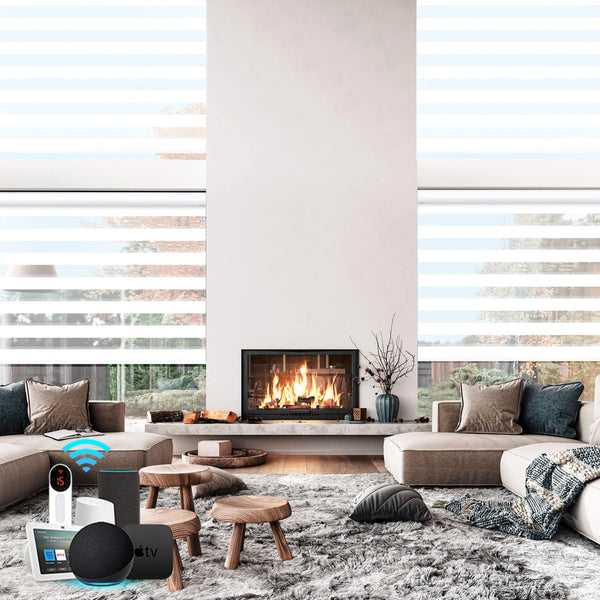
The Bringnox Motorized Zebra Roller Blinds 100% Blackout demonstrate this roller-driven arrangement. The remote can operate up to 15 shades together or individually and save a favorite intermediate position, making it suit the room with several windows.
How Zebra Shade Positions Affect Light and Privacy
Open, partially closed, closed, and fully raised are not separate operating modes. They are different results produced by changing stripe alignment, fabric height, or both.
|
Position |
Band Relationship |
Light Effect |
Privacy Effect |
|
Open |
Sheer bands align |
Most filtered daylight |
Limited privacy |
|
Partially closed |
Bands overlap unevenly |
Lower brightness and glare |
Moderate coverage |
|
Closed |
Solid bands cover sheer openings |
Least light through the fabric area |
Stronger privacy |
|
Fully raised |
Fabric collects near the headrail |
Window is exposed |
No privacy |
What Happens in the Open Position?
Aligned mesh bands establish a sightline through both fabric layers. Daylight still passes through two pieces of material, so it appears more diffused than light entering through bare glass.
Open is the brightest zebra-shade position, but it is not a dependable nighttime privacy setting. When indoor lights are brighter than the space outside, shapes and movement may remain visible.
What Happens in the Partially Closed Position?
As a solid band enters the sheer opening, that opening becomes narrower. Less of the outdoor view remains visible, and the light entering the room decreases.
This position is useful when fully open bands feel too bright, but a closed pattern feels unnecessarily dark. Small roller movements can change the result without moving the bottom rail to a noticeably different height.
What Happens in the Closed Position?
Here, the striped layers are staggered. Solid sections cover the sheer openings, reducing both visibility and incoming light across the main fabric area.
Why Can a Closed Zebra Shade Still Leak Light?
Even a fabric described as blackout does not guarantee a completely dark room after installation. Narrow side gaps can remain between the shade and window frame. Light may also enter near the cassette or through small openings where the stripes do not fully meet.
For bedrooms, nurseries, or media rooms that require deeper darkness, single-panel blackout roller shades may provide a simpler surface to seal around.
An outside mount or compatible side treatment can further reduce edge light, provided the window and product support that installation.

FAQs
Why are the stripes on my zebra shade not lining up?
Sideways fabric tracking, uneven tension, material rubbing inside the cassette, or incorrect motor limits can also disturb alignment. First, check whether the headrail and bottom rail are level. If the fabric bunches or repeatedly travels toward one side, stop operating the shade and follow its adjustment or recalibration instructions.
What is the difference between zebra shades and roller shades?
A standard roller shade uses one flat panel. It changes light primarily by covering more or less of the window. A zebra shade creates two striped layers, allowing band overlap to adjust light while the shade remains lowered.
Can zebra shades be installed on a shallow window frame?
Yes, but a shallow recess may not hold the entire cassette for a flush inside mount. Check the minimum depth required by the exact model before ordering.
Can zebra shades cover a wide window or sliding glass door?
They can work on some wide windows and doors, provided the model supports the required dimensions. Multiple shades can offer easier operation, but their center gaps and door-handle clearance must be planned before measuring.
How should zebra shade fabric be cleaned?
Begin with gentle dry cleaning, using a microfiber duster or a vacuum fitted with a soft brush attachment. Avoid soaking the layered material, creasing the bands, or allowing moisture to reach the motor and electrical components.
Final Takeaway
The essential zebra shade mechanism is a continuous striped fabric arranged into front and rear layers. A rotating tube shifts those layers, and their sheer-to-solid alignment determines how much light and visibility pass through.
Whether the tube is driven by a chain, cordless spring, or motor, the layered principle stays the same. Closing the bands increases coverage, but the final room-darkening result still depends on fabric opacity, precise alignment, mounting, and light gaps around the shade.