



Do Soundproof Blinds Work? How Much Noise Can They Reduce?
Soundproof blinds can soften everyday noise and reduce echo, though ordinary indoor blinds cannot make a room soundproof. Homeowners and renters dealing with street noise or nearby voices should expect a modest improvement in comfort rather than silence. The result depends on the window and the sound.
How Do Soundproof Blinds Reduce Noise?
Most products sold as soundproof blinds provide sound absorption. Their fabric reduces some of the sound that reflects from hard glass into the room. True sound isolation requires a heavy, airtight window assembly.
Sound absorption and sound isolation differ
Sound absorption reduces the sound that reflects around a room. Soft blind fabric takes in part of the sound energy near the glass, which can shorten echoes and make voices or traffic sound less sharp. Soundproof blinds provide some absorption because they add a soft layer over the window. Their lightweight fabric offers limited isolation against outdoor noise.
Sound isolation limits how much noise passes through a window. It depends on heavy glass, strong frames, and sealed gaps.
Noise also enters through glass and gaps
Glass vibrates when sound reaches it. Worn seals around an operable sash give airborne noise another path. A blind mounted on the room side cannot repair either weakness.
Close the window and listen near its edges. More sound beside a joint can indicate a seal problem. The glass may remain the main path after weatherstripping or frame repairs.
Higher sounds respond better than low rumble
Voices and tire hiss contain energy that soft fabric can absorb more readily. Cellular shades also reduce short reflections near the glass.
Truck engines and bass travel through lightweight materials more easily. Their long wavelengths also excite the window and surrounding structure. A blind may make the room less echoic while the low rumble stays clear.

How Much Noise Can Soundproof Blinds Reduce?
Published evidence does not support one universal reduction for indoor blinds. Indoor blinds usually offer acoustic softening. A seller should provide the exact test method before attaching a number to a residential shade.
Why a sound absorption percentage can mislead
Absorbed sound energy and room-level reduction are separate measurements. A shade may absorb energy that would otherwise reflect from the glass while allowing almost the same outdoor sound through the window.
Decibels use a logarithmic scale. A 3 dB change represents a halving of sound energy under equal conditions, according to the NIOSH explanation of the equal-energy rule. It does not automatically feel half as loud.
Useful documentation identifies the open and closed conditions, frequency range, and tested assembly.
How to check the result in your own room
Use the same phone and position for a simple before-and-after check. Record the average A-weighted level for at least 30 seconds with the shade open, then repeat while the noise source remains steady and the shade is fully closed.
A phone app cannot replace a calibrated meter, though it can reveal a repeated change in one room. Run paired readings without comparing different traffic events.
Which Soundproof Blinds Work Best?
Soft fabric, layered construction, and broad window coverage can help create a quieter indoor environment. The noise-reducing effect of blinds cannot be guaranteed because results depend on the window, installation, room, and sound source.
Cellular shades add depth near the glass
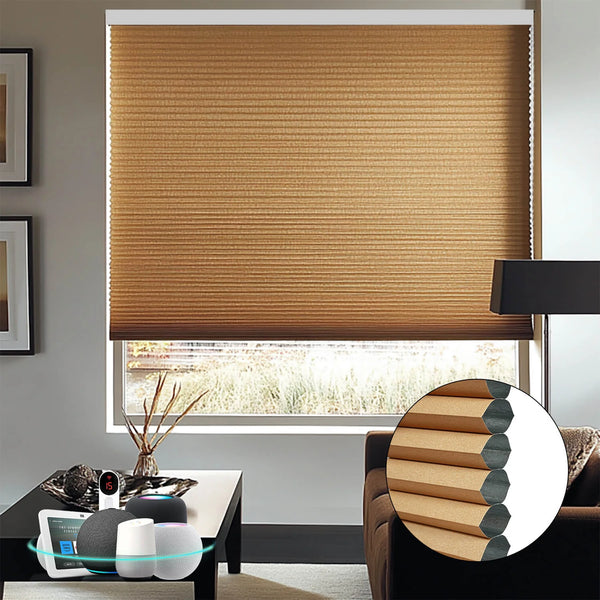
Cellular shades use folded honeycomb fabric with enclosed air pockets. This structure adds more fabric depth near the window and may help soften voices, street activity, and sound reflected from bare glass.
Double-cell shades contain more folded fabric than many single-cell designs. The added material may provide more surface for absorbing reflected sound. Cell depth, fabric density, window coverage, and installation also affect the final experience.
The Bringnox Blackout Motorized Cellular Shades use 38 mm polyester cells with blackout fabric. The cellular construction supports a softer room environment, while the opaque surface controls light and privacy. Motor operation below 45 dB suits bedrooms and home offices where quiet adjustment matters.
Heavy roller shades provide full coverage
A dense roller shade places a continuous fabric surface over the glass. This coverage may soften some higher-frequency sounds and reduce reflections from an uncovered window.
Custom motorized blinds can remain fully lowered during sleep or focused work. Blackout fabric also controls outside light and nighttime privacy, making these shades practical when several comfort needs must be handled together.
Double blinds add another fabric layer
Double blinds combine light-filtering and blackout fabrics at one window. The extra fabric layer increases coverage and may soften some sound around the glass when the shade is lowered.
The light-filtering layer supports daytime use, while the blackout layer provides stronger nighttime coverage. This format works well for rooms that need flexible light control together with a calmer indoor feel.
How Should You Choose Soundproof Blinds?
Match the shade to the noise problem using sound type, window condition, structure, coverage, test evidence, and daily operation.
Identify the sound before choosing a blind
Cellular shades may be more useful for voices, tire hiss, and room echo than for truck rumble or bass. Low-frequency noise needs a heavier window solution, so spending more on fabric may bring little improvement.
Check the window condition first
Close the sash and listen around the frame. A louder edge can indicate worn weatherstripping or a fixed crack that gives airborne sound a direct path. Repair failed seals before ordering.
If the frame is sound and low-frequency noise remains strong, the glass may be the limiting part. An acoustically rated insert or replacement window will usually offer more potential than another fabric layer.
Compare shade structure and fabric
Choose cellular construction when noise reduction is the priority. Compare fabric, cell depth, and operating method after the acoustic need is clear. Select blackout fabric when darkness and nighttime privacy also matter.
Verify every acoustic rating
Request the complete report when a seller advertises a decibel or percentage reduction. It should identify the standard, specimen, mounting method, frequency range, and tested condition.
An NRC or absorption coefficient concerns reflected sound. STC rates transmission through an eligible tested assembly, while OITC gives more weight to outdoor low-frequency noise. The rating must belong to the exact fabric and configuration being purchased.
Know when blinds will not be enough
Persistent aircraft noise, heavy traffic rumble, or structural vibration usually exceeds what indoor blinds can handle. Compare complete window assemblies with published OITC data.
A window professional can assess seals and glazing. Use an acoustical consultant when sound also reaches the wall or ceiling.
FAQs
Do soundproof blinds help renters?
Yes, modestly. Cellular shades and lined curtains can reduce reflections without replacing the window.
Do soundproof blinds need professional installation?
Usually no. Standard shades can be installed with accurate measurements and secure brackets. Use a professional for oversized windows, damaged frames, or powered wiring.
Do soundproof blinds reduce air conditioner noise?
Sometimes. They may soften reflection from an outdoor unit heard through the window. Mechanical vibration traveling through the structure requires service or vibration control at the source.
Can window film make blinds more soundproof?
Standard film offers little acoustic change. It is too thin to add meaningful mass. A purpose-built interior window insert creates a deeper sealed air space and has stronger potential.
Can soundproof blinds reduce rain noise?
Only slightly. Fabric can soften indoor reflections after rain strikes the glass. It cannot stop the glass from vibrating, so heavy rain may remain clear.
Are Soundproof Blinds Worth It?
Soundproof blinds are worthwhile when you want less echo, softer high-frequency noise, and better light control from one window treatment. Cellular shades provide the strongest common blind structure, especially with accurate sizing and broad glass coverage.
Expect limited help with bass or severe transportation noise. Seal air leaks first, ask for product-specific acoustic tests, and move to an OITC-rated window solution when a measurable reduction is the main buying goal.