

Single-Cell vs. Double-Cell Honeycomb Shades: R-Value, DOE Insulation Data & Upgrade Math
Do double-cell honeycomb shades justify their upgrade cost? Review exact U.S. DOE heat-loss benchmarks (10% heating savings), AERC climate ratings, expired 25C tax rules, and the true payback formula.

The quick verdict: According to U.S. Department of Energy (DOE) Energy Saver guidance, tightly installed motorized cellular shades can reduce winter heat loss through windows by 40% or more (equating to roughly 10% savings in heating energy) and reduce unwanted summer solar heat gain through windows by up to 60%.
Double-cell fabrics layer two front-to-back rows of air chambers, while single-cell foil-lined blackout shades (starting at $139.00+ base at Bringnox) pair one pleated air layer with an internal opaque barrier. Exact recess depth, raised stack height, fabric weight, and thermal performance vary by specific model, pleat size, and liner construction rather than cell count alone. Because standalone shade R-values shift sharply with baseline window glass (single-pane vs. low-E double-pane) and edge sealing, U.S. DOE and AERC evaluate full window-plus-attachment performance rather than a single universal shade R-value, so compare published per-SKU specs and AERC climate ratings before choosing.
Evidence & Scope Disclosure
Window heat-loss and solar heat-gain percentages below cite U.S. DOE Energy Saver benchmarks, Oak Ridge National Laboratory (ORNL) multi-model cellular studies, Pacific Northwest National Laboratory (PNNL) automated-control lab studies, and the AERC Residential Label. Bringnox cellular product pages feature single-cell honeycomb pleats (with internal blackout foil cores on blackout models) and do not publish AERC-certified lab sheets, so we do not invent brand R-values or whole-house utility payback years.

Single-Cell vs. Double-Cell Architecture: Physics & Hardware Trade-Offs
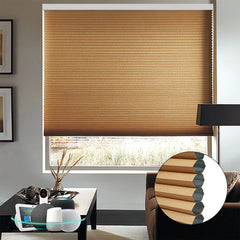
Cellular shades slow heat transfer by trapping still air inside pleated fabric pockets and creating an air buffer between the shade and the window pane. Single-cell fabrics stack one column of hexagonal chambers vertically; double-cell fabrics layer two narrower columns front-to-back.
| Design Factor | Single-Cell Honeycomb | Double-Cell Honeycomb |
|---|---|---|
| Pocket Structure | One row of pleated air chambers (optional internal blackout foil liner) | Two front-to-back rows of smaller air chambers adding conductive resistance |
| Recess Depth & Stack | Varies by pleat width (e.g., 3/8" vs. 3/4") and headrail cassette; confirm exact minimum depth and raised stack on each SKU | Varies by cell profile and fabric density; verify exact minimum mounting depth and raised stack height against your window frame |
| Motorized Lift Weight | Depends on fabric GSM, foil liner, and window dimensions; confirm motor sizing on wide or tall spans | Depends on exact double-layer fabric weight and window area; verify motor lift capacity per SKU on wide spans |
| How to Evaluate Fit | Compare exact SKU depth, blackout foil liner option, and base pricing ($139.00+ at Bringnox) against your glass type | Compare certified same-window AERC Cool/Warm Climate ratings, exact depth, and installed cost against single-cell options |
Reading DOE Percentages & AERC Climate Labels Correctly
Window-covering marketing routinely mixes denominators, turning window-level percentages into inflated whole-home utility promises. Separate three distinct benchmarks before evaluating any shade:
- Winter Window Heat Loss vs. Heating Energy (DOE Energy Saver): Tightly fitted cellular shades can reduce heat loss through the windows by 40% or more during heating seasons, which DOE Energy Saver translates to roughly 10% savings in heating energy (not 40% off your total gas or electric bill, because walls, roofs, air leaks, and appliances account for the rest of household energy use).
- Summer Window Solar Heat Gain (DOE Energy Saver): When closed during peak sun, cellular shades can reduce unwanted solar heat gain through windows by up to 60%, again measured at the window glazing, not as a 60% reduction in total monthly air-conditioning bills.
- How AERC Climate Ratings Complement Standalone R-Values: Standalone R-values depend heavily on the baseline glass behind the shade. On the AERC Residential Label, certified attachments show separate Cool Climate (heating-focused) and Warm Climate (cooling-focused) ratings, plus an optional with-automation rating, calculated from U-factor, Solar Heat Gain Coefficient (SHGC), and air leakage over reference windows.
Fabric opacity also matters: foil-lined blackout cellular fabrics add a radiant barrier inside the cell compared with translucent light-filtering cloth. Compare both styles in our blackout vs. light-filtering cellular efficiency overview and cellular shades energy guide.

How Automated Schedules Support Real-World Window Efficiency
Independent studies from ORNL (evaluating multiple single- and double-cell cellular shade models) and PNNL (evaluating automated dynamic-control strategies on specific cellular products in test homes) point to two distinct levers: physical cell construction and timely daily operation.
Manual shades left open during peak July afternoon sun or winter twilight cannot deliver their rated window barrier. Scheduling motorized cellular shades to close south- and west-facing panes during peak afternoon sun in summer, or close at sunset in winter, helps homeowners capture consistent daily closure. (Note: because ORNL and PNNL evaluated different product sets and controls, do not assume motorizing a single-cell shade automatically beats a double-cell shade without same-window test data.)
6-Window Base Hardware Costs & The Honest Upgrade Payback Formula
Never estimate payback by dividing a 6-window purchase price by your entire home's annual HVAC bill, six windows represent only a fraction of your home's total building envelope, and realized savings depend on climate zone, glass type (single-pane vs. modern low-E double-pane), existing window coverings, and utility rates.
To judge whether upgrading from one shade tier to another (such as single-cell to double-cell, or manual to motorized) pays back on energy bills alone, use the incremental formula:
Incremental Payback (Years) = (Total Installed Cost of Upgraded Tier − Total Installed Cost of Baseline Tier) ÷ Verified Annual Incremental Energy Savings ($)
Because verified same-window incremental utility savings vary dramatically by house, and Bringnox does not publish AERC lab ratings for its cellular lineup, evaluate Bringnox's 6-window base hardware tiers primarily as transparent upfront comfort, privacy, and automation budgets (before custom sizing, smart-motor upgrades, or accessories):
| Bringnox Cellular Model (Single-Cell) | Published Base Price / Window | 6-Window Base Reference | Primary Functional Upgrade |
|---|---|---|---|
| Blackout or Light-Filtering Cellular | $139.00+ | $834.00 base | Everyday inside-mount thermal buffer; blackout SKU adds internal foil liner |
| No-Drill Blackout Cellular | $149.00+ | $894.00 base | Screw-free inside-jamb tension mounting for solid parallel apartment frames |
| Top-Down Bottom-Up (TDBU) Cellular | $219.00+ | $1,314.00 base | Lower top rail for passive winter daylight while screening lower eye-level glass |
| Day & Night Cellular | $269.00+ | $1,614.00 base | Light-filtering and foil-lined blackout honeycomb tiers stacked in one frame |
Matching Bringnox Cellular Models to Window Fit
Tight perimeter fit matters as much as pleat geometry because air circulating around loose outside edges bypasses the honeycomb cells. Mount tightly inside the window recess whenever frame depth allows:
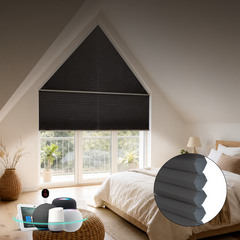
- Bedrooms & Radiant Blocking: Bringnox Blackout Motorized Cellular Shades ($139.00+) pair foil-lined pleats with full through-fabric light blocking.
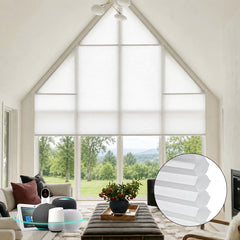
- Daytime Living Areas: Bringnox Light Filtering Motorized Cellular Shades ($139.00+) diffuse harsh sun while keeping rooms bright.
- Street-Level Privacy + Upper Light: TDBU Cellular Shades ($219.00+) or Day-Night Cellular Shades ($269.00+) combine privacy and flexible daylighting (see top-down bottom-up shades guide).
- Rentals: No-Drill Blackout Cellular Shades ($149.00+) fit solid parallel inside jambs without screws.

Battery-configured cellular motors carry a manufacturer-rated 4 to 6 months per charge (depending on shade size, daily cycles, and room temperature), with optional Bringnox Solar Panels ($39.90) for sunny windows and 15-Channel Remotes ($20.00) for manual group control; automated sunrise/sunset schedules require a compatible smart-home ecosystem (native Matter over Thread requires both a Matter Controller and a Thread Border Router).
All Bringnox cellular shades include a 3-year limited warranty, report any visible delivery or installation damage to Bringnox within 3 days, or the warranty is voided, and optional $29.99 MeasureFit Guarantee coverage per shade (30 days from receipt, 1 remake per item: free within 1 inch / 2.54 cm, size difference only above 1 inch, shipped without the motor). Order fabric swatches ($0.90+) first to check pleat density and color in your window light.
Frequently Asked Questions
Do motorized cellular shades qualify for the federal Section 25C energy tax credit in 2026?
No. Per IRS Form 5695 instructions, the federal Energy Efficient Home Improvement Credit (Section 25C) expired for property placed in service after December 31, 2025, so 2026 shade installations are ineligible. Check only your local electric or gas utility for any active regional window-attachment rebate programs.
Why do some brands cite R-value while the AERC label shows Cool and Warm Climate ratings?
Standalone R-values shift depending on the glass behind the shade and test setup. The AERC residential label compares products consistently over reference windows using separate Cool Climate and Warm Climate energy ratings (plus an optional automated-control rating) calculated from U-factor, SHGC, and air leakage.
Are double-cell honeycomb shades always better than single-cell shades?
Not universally. Real-world thermal performance, mounting depth, raised stack height, and fabric weight depend on each specific model's pleat size, fabric density, and internal foil liner rather than cell count alone. Before paying extra for a double-cell SKU, compare published mounting depth, raised stack specs, and same-window AERC Cool/Warm Climate ratings (when available) side by side.
Do blackout cellular shades block more radiant heat than light-filtering cellular shades?
Generally yes. Foil-lined blackout honeycomb pleats include an opaque internal barrier inside the cell that reflects radiant energy in addition to trapping still air, helping reduce summer solar glare and cold winter glass feel more effectively than translucent pleats.

Have a Window Measurement or Smart-Home Question?
Leave your window width, mount type, or smart-home setup below—our product team reviews reader questions.